A Christmas pilgrimage to Bethlehem and Jerusalem includes attending Midnight Mass at St. Catherine’s Church on Christmas Eve, visiting the Church of the Nativity and the Grotto of the Birth, and experiencing Jerusalem’s Old City across three Christmas celebrations: Western (December 25), Orthodox (January 7), and Armenian (January 18-19).
Most people celebrate Christmas with some version of the same thing: candles, carols, a nativity set on the mantle that has been there since childhood. The story is so familiar it can stop being a story. It becomes scenery.
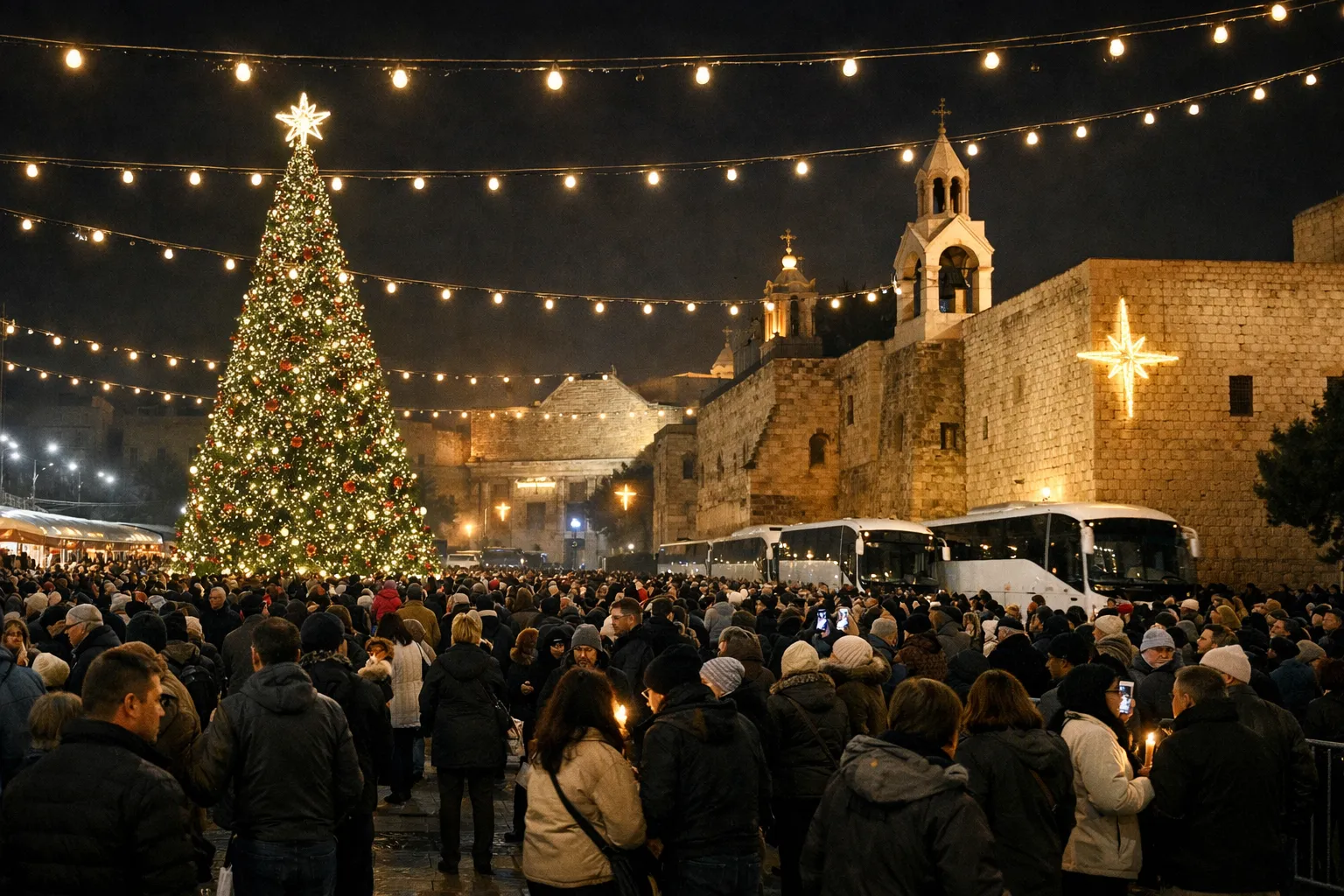
Standing in Manger Square on Christmas Eve changes that. Not because the square is quiet or sacred in the way you might imagine. It is not. It is loud and crowded and lit up, and there is a brass band somewhere you cannot quite locate, and the air smells like roasted chestnuts and diesel from the coach buses parked three streets over. But then a group of pilgrims near you starts singing “O Little Town of Bethlehem,” and you realize where you are, and something cracks open in your chest that has been closed for a long time.
That is what a Christmas pilgrimage to the Holy Land does. It does not give you a peaceful, pastoral nativity. It gives you the real thing: a real town, real crowds, real cold, and underneath all of it, the weight of what actually happened here.
What Bethlehem looks like in December
Bethlehem is a Palestinian city of about 25,000 people, six miles south of Jerusalem in the West Bank. The crossing from Jerusalem takes about twenty minutes with a tour operator, who handles the checkpoint logistics. Most pilgrims are barely aware of crossing.
The city has been celebrating the birth of Jesus in some form since the second century. The Church of the Nativity, built over the cave that early Christians identified as the birthplace, is the oldest continuously operating Christian church in the world. Its walls have absorbed seventeen centuries of Advent and Christmas liturgy.
In December, the city leans into Christmas fully. Manger Square, the open plaza in front of the Church of the Nativity, is strung with lights. A large tree goes up in the center. The municipality organizes concerts and events through December. Local Palestinian Christian families dress up. Children are everywhere.
The mood is joyful in a way that catches some visitors off guard, especially those who arrive expecting hushed reverence. The reverence is there too, but so is noise, motion, and the ordinary life of a city that has been celebrating this particular birthday for a very long time.
December crowds in Bethlehem are significant on Christmas Eve and Christmas Day, but the city is far less congested than it would be in summer. Most major sites in Jerusalem are also lighter in December than in April or October. For groups who want unhurried time at sites, and who are willing to pack a rain jacket, December is genuinely one of the better months to go.
For general planning logistics, including how to structure your group’s itinerary across the whole trip, the complete guide to planning a church pilgrimage to Israel covers the ground in detail.
The Church of the Nativity: the cave, the star, the line
The entrance to the Church of the Nativity is through the Door of Humility, a low stone opening about 1.2 meters high. Every person who enters has to bend down to pass through. It was built that way in the sixteenth century to prevent people riding horses inside, but the effect it has on pilgrims is consistent. You arrive expecting to walk in and you are immediately stopped, made small, asked to bow before you enter.
The church interior is ancient and worn. The floor dates largely to a fourth-century renovation. Byzantine mosaics are visible in sections beneath wooden trapdoors. The nave is long and dim, with rows of pink limestone columns. It does not look like a showpiece. It looks like a place that has been used every day for a very long time.
The cave beneath the main altar is reached by narrow stone stairways on either side of the sanctuary. At the center of the cave floor, embedded in marble, is a fourteen-pointed silver star. An inscription in Latin around it reads: “Here Jesus Christ was born of the Virgin Mary.” Above it, hanging lamps burn constantly. The cave is small and often crowded, and the wait in line can be thirty to sixty minutes on ordinary December days, and several hours on December 25.
Plan your group’s visit for early morning on a non-Christmas-Day date if you want room to breathe. The cave is quieter at 7 or 8 a.m. than at any other point in the day. If your trip includes Christmas Day, many groups visit the cave in the days before and use Christmas itself for the square, the Mass, and the atmosphere rather than a second trip into the line.
Luke 2:6-7 gives the account in seven words of the actual event: “She gave birth to her firstborn, a son.” No choir. No fanfare. A woman gave birth in a cave while travelers filled every room in the village. The star on the floor of that cave marks the most understated entrance of anyone who has ever entered the world.
Reflection: What does it mean to you that God chose a cave? Not a palace, not a temple, not even a proper room. What does that choice say about how and where God tends to show up?
Midnight Mass at St. Catherine’s Church
St. Catherine’s Church sits directly adjacent to the Church of the Nativity, connected by a short corridor. It is the Roman Catholic church of Bethlehem, built in the 1880s on the site of an earlier Crusader chapel. On Christmas Eve, it is the location of the most-watched Mass in Christendom. The service is broadcast live by television networks around the world.
The interior holds only a few hundred people. Tickets for seating inside are distributed by the Latin Patriarchate of Jerusalem, and demand far exceeds supply. Requests made through your tour operator several months in advance give you the best chance, but are not guaranteed. Many groups who cannot secure interior tickets instead gather in Manger Square, where the Mass is broadcast on large screens and the crowd is part of the experience.
The service begins around 11:00 p.m. on Christmas Eve and runs past midnight. The Latin Patriarch of Jerusalem presides, typically with international church delegations present. The music is sung in Latin and Arabic. The homily is usually given in several languages. It is formal and ancient-feeling in a way that a lot of Protestant visitors do not expect to find moving, and then find deeply moving anyway.
If your group is watching from the square, arrive by 9:00 p.m. to secure a clear sightline to one of the screens. Bring blankets. December nights in Bethlehem are cold, usually between 4 and 8 degrees Celsius, and you will be standing on stone for two or three hours. The cold is part of it. The shepherds in the fields around this city were cold the night the angels came.
Isaiah 9:6 has been read at Christmas liturgies since the early church: “For to us a child is born, to us a son is given, and the government will be on his shoulders. And he will be called Wonderful Counselor, Mighty God, Everlasting Father, Prince of Peace.” Hearing it read in this city, at this hour, with this crowd, is not the same as hearing it in a warm sanctuary back home.
Shepherds’ Field at dawn on Christmas morning
Three miles east of Bethlehem, the terraced hills flatten into open grazing land above the village of Beit Sahour. This is Shepherds’ Field. The Franciscan chapel there is small and plain, built in the 1950s over the ruins of earlier Byzantine and Crusader structures. The grounds are quiet.
Come here on Christmas morning, early. Before the coaches arrive, before anything is organized or scheduled. The light comes up slowly over the hills to the east, and the fields are cold and still. There are actual sheep. You can hear them.
Luke 2:8-9 reads: “And there were shepherds living out in the fields nearby, keeping watch over their flocks at night. An angel of the Lord appeared to them, and the glory of the Lord shone around them, and they were terrified.” Reading that passage here, in the open air, at dawn on December 25, with the lights of Bethlehem visible on the hill above you, removes a layer of abstraction that most people do not even know they have been carrying.
The Franciscan chapel holds a small morning service on Christmas Day. It is typically attended by a mix of pilgrims and local Christians. The service is simple. The singing is not polished. It is exactly the right scale for that morning and that place.
This is the moment many pilgrims later name as the one that stayed with them most. Not the Midnight Mass with its crowds and lights. Not the queue to see the star. Dawn at Shepherds’ Field, cold and quiet, with the city below and the open sky above.
Reflection: The shepherds were the first people told. Not priests, not scholars. The people who were already outside, already awake, already in the dark. Who in your congregation or community is already out in the fields? What announcement are you being called to bring them?
Christmas in Jerusalem: how the city marks it
Jerusalem observes Christmas three times, which is one of the stranger and more beautiful facts about the city.
Western Christians, Roman Catholics and most Protestant denominations, celebrate on December 25. The Christian Quarter of the Old City is decorated with lights from early December. The Armenian Patriarchate hosts Christmas services in the Cathedral of Saint James. The Lutheran Church of the Redeemer, inside the Old City, holds Christmas Eve and Christmas Day services that welcome international visitors. The Church of the Holy Sepulchre holds a Christmas processional for Catholic and other Western congregations.
Orthodox Christians, including Greek Orthodox, Russian Orthodox, Romanian, and others using the Julian calendar, celebrate on January 7. The Greek Orthodox Patriarchate holds a Christmas liturgy at the Church of the Holy Sepulchre that is strikingly different from anything most Western visitors have attended. Incense, ancient chant, robes heavy with gold thread, and a liturgical rhythm that moves through hours rather than minutes. If your group travels in early January, attending even part of this service is worth the time.
The Armenian Apostolic Church celebrates Christmas on January 18 and 19, the latest of the three dates. The Armenian Quarter of the Old City, tucked behind the Zion Gate, is one of the least-visited parts of Jerusalem and one of the most historically layered. The community there is small and tight-knit and deeply rooted in a version of Christianity that goes back to the fourth century.
What this means practically for pilgrimage planning is that December and early January in Jerusalem are never without a Christmas. If your group cannot travel on December 25, a trip in the first two weeks of January gives you the Orthodox Christmas in both Bethlehem and Jerusalem, usually with smaller crowds and more space to move through the city. The Israel travel guide for Christian visitors has a broader look at navigating the city’s religious rhythms across seasons.
What to pack for December in the Holy Land
Jerusalem and Bethlehem sit at around 760 to 800 meters above sea level. That elevation means December temperatures that feel genuinely cold, particularly to visitors from warmer climates. Daytime highs are typically between 10 and 15 degrees Celsius. Nights drop to 4 or 6 degrees, sometimes lower. Rain is possible throughout December and more likely from mid-month on.
Layers are more useful than one heavy coat. You will be moving between cold outdoor sites and heated churches and restaurants, sometimes within the same hour. A lightweight down jacket over a fleece over a base layer gives you more flexibility than a single parka.
Walking shoes need to be waterproof and comfortable on wet stone. The streets of the Old City are paved with limestone that becomes slick when wet. Cobblestones and uneven surfaces are everywhere. Flat, grippy soles are the right call. Save the fashionable footwear for the dinner on the last night.
Carry a small backpack rather than a large bag. You will be ducking through low doorways, sitting in small chapels, and standing in lines in narrow spaces. Anything you have to take off your shoulder repeatedly becomes a source of frustration.
Bring a compact umbrella or a waterproof shell that folds small. Rain in Jerusalem is not usually heavy, but a cold drizzle on the Via Dolorosa or in the Church of the Nativity queue is harder to ignore when you are not prepared for it.
The upside of the cold is that it is honest. A warm, comfortable December is pleasant. A cold, occasionally rainy December in Bethlehem is closer to what the story actually was.
Advent devotionals to do with your group before you leave
The six to eight weeks before a Christmas pilgrimage are not dead time. They are the preparation, and if you use them well, your group will arrive in Bethlehem already oriented toward what they are about to see.
Read Luke 1 and 2 together, slowly. Not in one sitting. Luke 1 in one meeting, Luke 2 in another. Pay attention to the geography: the angel appears to Mary in Nazareth. She travels to visit Elizabeth in the hill country of Judea. She and Joseph travel from Nazareth to Bethlehem for the census. These are real distances. Nazareth to Bethlehem is about 90 miles on foot through difficult terrain. When your group walks the same landscape in December, they will have a sense of what that journey cost.
Assign each member of your group a figure from the nativity narrative and ask them to prepare a brief reflection. Not just Mary and Joseph. The innkeeper who turned them away. The shepherds who left their flocks in the middle of the night. The Magi who followed a star for months. What does each of them know and not know at the moment they appear in the story? Asking this question opens the text in ways that standard Christmas sermon prep usually does not.
Use the traditional Advent texts, not only the familiar Christmas ones. Isaiah 40:3-5 and Micah 5:2 are prophecies your group will hear referenced in Bethlehem. Arriving with those passages already in their heads changes how they receive them on-site.
For pastors thinking through the spiritual preparation in more depth, the full guide to preparing your heart and your congregation for Holy Land pilgrimage covers the devotional and logistical preparation in detail.
Pray Psalm 80 together one Sunday before you leave. It is a psalm of longing, a plea for God to show up and restore what has been lost: “Restore us, O God; make your face shine on us, that we may be saved” (Psalm 80:3). It is an Advent psalm before Advent had that name. Your group will recognize the feeling when they are standing in Manger Square and the lights come on.
Reflection: Advent is a season of waiting for something that has already come. Where in your life are you still waiting for God to arrive? What would it mean to hold that waiting alongside the certainty of the nativity?
The three Christmases: planning your timing
The overlap of three Christmas dates in Jerusalem is not a curiosity. It is an invitation to think about the breadth of the church. Roman Catholics and Protestants, Greek and Russian Orthodox, Armenian and Coptic and Ethiopian Christians, all of them celebrating the same event with different calendars and different rites in the same city and the same building.
If your group travels on December 25, you will be in the larger Western Christmas crowd, which is significant but manageable with a good operator. The ceremony in Manger Square is lively and well-organized. The atmosphere is genuinely festive.
If your group travels in early January and attends the Orthodox Christmas on January 7, you will have a different and quieter experience. January also gives groups the chance to extend south toward the Jordan Valley, and a stop at Yardenit or Qasr el-Yahud fits naturally into the itinerary. The Jordan River baptism guide covers both sites and how to structure the ceremony for a church group. The crowds in Bethlehem for Orthodox Christmas are smaller than December 25. The liturgy is longer and more formal. Orthodox Christmas in Jerusalem, at the Church of the Holy Sepulchre, is one of the most visually striking religious ceremonies in the city.
Traveling for Armenian Christmas in mid-January means very thin crowds, cold weather, and an experience that almost no Western pilgrim has. The Armenian Quarter of the Old City becomes the center of its own world for those two days. It is not the version of Christmas most visitors go looking for. It is remarkable for precisely that reason.
A note on December pricing and what to budget for a church group trip: December is generally lower demand than spring, but Christmas week itself has elevated costs. Early January trips often offer better value and a more spacious experience at the major sites.
What it means to celebrate Christmas where it happened
There is a question that comes up quietly in almost every Christmas pilgrimage group, usually on the second or third day. Someone voices it, or almost voices it, and others nod. It is some version of: does it matter that I am here? Not theologically. Personally. Does being here change anything?
The honest answer is: it might. And it probably will not be in the way you expected.
Some people arrive in Bethlehem and feel, for the first time in years, that the Christmas story is not a metaphor. It is an address. A real cave, a real city, a real star in the sky above real fields. The doctrine of the incarnation, that God became flesh and lived in a specific place at a specific time, is easier to hold onto when you have stood in that place.
Others feel the strangeness of the crowds, the commercial elements, the layers of centuries-old argument between Christian communities over which inch of which floor belongs to which tradition, and find themselves, oddly, more honest about their faith than they were when they left home. The Holy Land does not hand you simple certainties. It gives you complicated, layered, contested reality and asks you to find Jesus in the middle of it.
Both of these are good outcomes. The first is easier to talk about. The second may be more lasting.
John 1:14 puts it this way: “The Word became flesh and made his dwelling among us. We have seen his glory, the glory of the one and only Son, who came from the Father, full of grace and truth.” The Greek word for “made his dwelling” is eskénosen, from the word for tent. God pitched a tent among us. A temporary, portable, impermanent structure. In a cave, in a small city, in a province of the Roman Empire, in the middle of the ordinary world.
You are going to stand in that cave. You are going to put your hand near that star on the floor. You are going to walk out into the cold Bethlehem night and hear people singing in languages you do not know.
That is where the Word became flesh. Right there.
For a deeper look at the archaeological and historical layers underneath the Church of the Nativity and other key sites your group will visit, what the biblical sites of Israel reveal archaeologically is worth reading before you go.