The Dead Sea Scrolls are approximately 900 ancient manuscripts discovered between 1947 and 1956 in caves near Qumran on the Dead Sea’s northwestern shore, including the oldest known copies of every book of the Hebrew Bible except Esther, with the Great Isaiah Scroll dating to roughly 125 BCE — over 1,000 years older than the previously oldest known Hebrew copy.
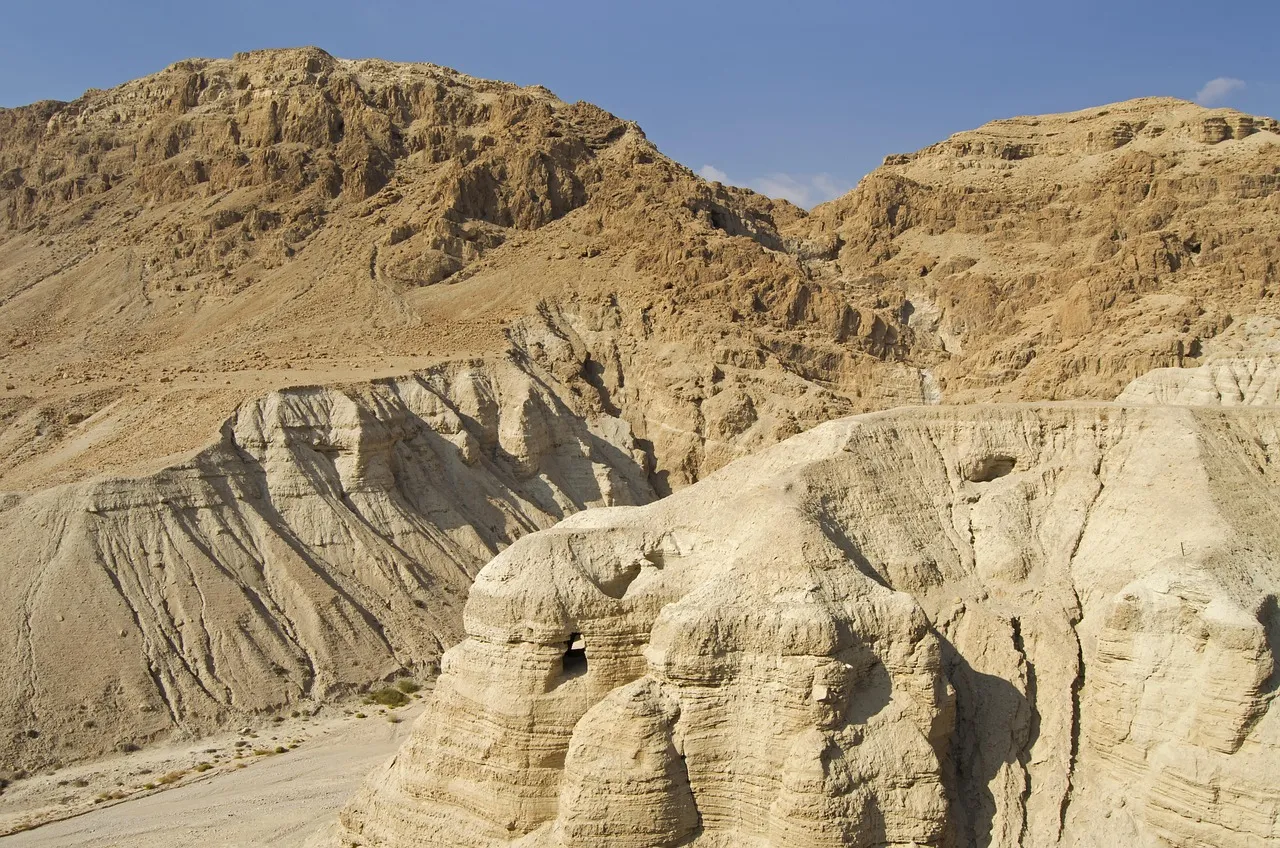
In the winter of 1946-47 — the exact date is debated — a Bedouin shepherd named Muhammad edh-Dhib was searching for a lost goat along the cliffs above the northwestern shore of the Dead Sea. He found a cave. Inside it were ceramic jars, and inside the jars were leather scrolls wrapped in linen. He thought they might be worth something. He was not wrong, though it would take years for the scholarly world to understand how extraordinary the find actually was.
What Muhammad edh-Dhib stumbled into was roughly 900 manuscripts ranging from the late 3rd century BCE to approximately 68 CE, recovered over the next decade from eleven caves in the surrounding cliffs. They include the oldest surviving copies of nearly every book of the Hebrew Bible. They include the governing documents of a Jewish community that was already ancient by the time of Jesus. They have revised what historians thought they knew about 1st-century Judaism, and they have demonstrated, through direct textual comparison, a level of scribal fidelity in the transmission of the Hebrew scriptures that no one had previously been able to test.
If you are planning a pilgrimage to Israel and you are not planning to visit the Shrine of the Book at the Israel Museum, you are skipping the single most important collection of ancient manuscripts in the world.
The discovery: how it happened
The story of the first cave is well documented, though the precise date has been contested since the 1990s when scholars Weston Fields and Norman Golb re-examined the original accounts. The most widely accepted reconstruction places the initial discovery in late 1946 or early 1947.
Muhammad edh-Dhib was from the Ta’amireh Bedouin tribe. He retrieved several scrolls and brought them to an antiquities dealer in Bethlehem named Khalil Iskander Shahin, known as Kando. Kando sold some of the scrolls to Mar Athanasius Yeshue Samuel, the Syrian Orthodox archbishop of Jerusalem, and others reached Professor Eleazar Sukenik of the Hebrew University, who recognized their antiquity in November 1947 — the same week the United Nations voted to partition Palestine.
Formal excavation of the first cave (Cave 1) began in February 1949, led by G. Lankester Harding of the Jordanian Department of Antiquities and Roland de Vaux of the Ecole Biblique et Archeologique Francaise in Jerusalem. The excavation recovered pottery, linen wrappings, and additional scroll fragments. It also established the archaeological context that would anchor the dating of the find.
Between 1951 and 1956, de Vaux led excavations of the Qumran settlement itself and coordinated the search of eleven caves in the surrounding cliffs. Cave 4, discovered in 1952 roughly 100 meters from the main settlement, yielded the largest single find: fragments from approximately 575 different manuscripts, representing a significant portion of the total corpus. Many were in poor condition, reduced to thousands of small pieces that took decades to identify and reassemble.
The last major cave discovery before the 21st century was Cave 11, found in 1956, which contained the Temple Scroll — at 8.15 meters, the longest of all the scrolls, now held at the Israel Museum.
What was actually found
The ~900 manuscripts fall into three broad categories.
The biblical manuscripts are what most people come for. Fragments from every book of the Hebrew Bible have been found at Qumran — every book except Esther, and possibly Nehemiah (the evidence for a separate Nehemiah scroll is ambiguous). The most represented books are Psalms (with fragments from 36 manuscripts), Deuteronomy (29 manuscripts), and Isaiah (21 manuscripts), which reflects both their liturgical importance and, likely, the community’s theological interests.
The sectarian texts are documents the community at Qumran appears to have written themselves. These include the Community Rule (also called the Manual of Discipline), which describes the organization, rituals, and ethical standards of the group; the Damascus Document, which was actually known from a Cairo geniza discovery in 1896 before Qumran versions confirmed it was much older; the War Scroll, which describes an eschatological war between the “Sons of Light” and the “Sons of Darkness”; and the Thanksgiving Hymns (Hodayot), a collection of psalms possibly composed by the community’s founder, known only as the “Teacher of Righteousness.”
The third category is miscellaneous: biblical commentaries (pesharim) that interpret specific prophetic texts as fulfilled in the community’s own experience, calendrical texts, apocryphal works, phylactery texts, and documentary fragments.
The Great Isaiah Scroll
The most significant single manuscript from the Dead Sea is the Great Isaiah Scroll, now displayed at the Shrine of the Book in Jerusalem. It was found in Cave 1 in the original 1947 discovery, purchased by Eleazar Sukenik’s son Yigael Yadin in 1954 from an antiquities dealer advertisement placed in the Wall Street Journal, and brought to Israel. It has been at the Israel Museum since the Shrine of the Book opened in 1965.
The scroll is 7.34 meters long and contains all 66 chapters of Isaiah — the only complete biblical book preserved from Qumran. Radiocarbon dating and paleographic analysis by Frank Moore Cross and others date it to approximately 125 BCE. Before its discovery, the oldest known complete Hebrew manuscript of Isaiah was the Aleppo Codex, dated to approximately 920 CE. The Great Isaiah Scroll is roughly 1,050 years older.
What the scroll shows is not what many expected. When scholars compared it systematically with the Masoretic text used as the basis for modern translations, they found that the two texts agree in approximately 95% of their content. The remaining 5% consists of obvious scribal errors, spelling variations, and minor grammatical differences. There are no theologically significant variants. The words are the same.
This has direct implications for how Christian readers should think about the transmission of their scriptures. Isaiah 7:14, Isaiah 53, Isaiah 61 — the passages that New Testament writers quote in contexts directly connected to Jesus — appear in the Great Isaiah Scroll exactly as they appear in the Hebrew text underlying our modern translations. The chain of transmission held.
Most people who visit the Shrine of the Book spend a few minutes looking at the displayed section of the scroll through the glass and move on. The section on display rotates periodically, with different chapters exposed while others are protected from light. If you have read Isaiah before the visit and know which chapter is showing, it is a different experience entirely.
The Qumran community: who lived there
The settlement at Khirbet Qumran was excavated by Roland de Vaux between 1951 and 1956. What he found was a structured communal compound: a scriptorium where manuscripts appear to have been copied (ink wells and a long plaster bench were found), communal dining facilities, a complex water system with several ritual baths (miqva’ot), and a cemetery of roughly 1,100 graves to the east of the settlement.
De Vaux identified the occupants as Essenes, one of the three major Jewish sects described by the 1st-century historian Josephus alongside the Pharisees and Sadducees. Pliny the Elder, writing after 70 CE, explicitly places an Essene community “above En-Gedi” on the western shore of the Dead Sea — which matches Qumran’s location. The community rule documents recovered from the caves describe a group that held property in common, required strict ritual purity, practiced communal meals, and followed a solar calendar that put them at odds with the Jerusalem Temple establishment.
The Essene identification remains the scholarly majority position, but it has not gone unchallenged. Norman Golb of the University of Chicago has argued since the 1980s that Qumran was a military fortress, not a religious community, and that the scrolls were a library assembled from Jerusalem and hidden as the Romans advanced in 68 CE. Rachel Elior of the Hebrew University has argued that the Essenes may not have existed as a distinct group at all, and that the Qumran texts were produced by priestly circles displaced from Temple service after the Hasmonean consolidation of the high priesthood. Both arguments have been answered in detail — Jodi Magness of the University of North Carolina at Chapel Hill published what is currently the most thorough archaeological defense of the Essene-Qumran connection in “The Archaeology of Qumran and the Dead Sea Scrolls” (2002) — but neither has been entirely closed.
What the archaeology is clear on: the settlement was occupied in two main phases, from approximately 100 BCE to 31 BCE (when it appears to have been damaged and temporarily abandoned, possibly due to an earthquake), and then from approximately 4 BCE to 68 CE, when it was destroyed by Roman forces during the First Jewish Revolt. Arrowheads found in the destruction layer are consistent with Roman military activity.
The sectarian texts and what they tell us about Jesus’ world
For Christian visitors, the scrolls that often matter most are not the biblical manuscripts but the sectarian documents, because they illuminate the religious world Jesus inhabited.
The Community Rule describes a group that baptized initiates, shared meals that had a ritual character, expected a messianic figure, and organized themselves around an interpretation of the “new covenant” described in Jeremiah 31. None of this makes the community proto-Christian — their theology was different in significant ways — but it demonstrates that the concepts and vocabulary later central to early Christianity were already active within Judaism a century before Jesus.
The War Scroll describes a final cosmic conflict between the forces of light and darkness, using language that appears in modified form in the New Testament book of Revelation and in Paul’s letter to the Ephesians (the “armor of God” passage in Ephesians 6:10-17 has clear conceptual parallels with the War Scroll’s account of preparation for spiritual battle). The dualism is not identical, but the shared framework is unmistakable.
The pesharim — commentaries on Isaiah, Habakkuk, Nahum, and other prophets — show a community reading prophetic texts as directly predictive of events in their own lifetime. This interpretive method, which scholars call pesher interpretation, is exactly how the New Testament writers use many of the same prophetic texts. Matthew’s use of Isaiah 7:14, or the way the author of Acts 2 reads Psalm 16, follows the same basic move: this ancient text is being fulfilled right now, in us.
This does not reduce Christianity to a variant of the Qumran sect. It does mean that when Christian readers encounter the New Testament’s use of the Hebrew scriptures, they are seeing an interpretive practice that was current and recognizable within 1st-century Judaism, not something invented after the fact.
Where to see the scrolls today
Shrine of the Book, Israel Museum, Jerusalem
The Israel Museum’s Shrine of the Book is the primary destination. The building itself, opened in 1965 and designed by architects Frederick Kiesler and Armand Bartos, is recognizable by its white dome modeled on the lid of the scroll jars found in Cave 1. A contrasting black basalt wall beside it represents the Sons of Darkness described in the War Scroll.
Inside, the Great Isaiah Scroll is displayed in a circular case beneath the dome, unrolled around a drum so that visitors can see the text in sequence. Other items on display include the Community Rule, the Thanksgiving Hymns, the Pesher Habakkuk, and the Temple Scroll. Facsimiles are shown when originals are in storage for conservation, so it is worth checking the museum’s current display status before visiting.
Plan two hours minimum. The exhibit includes significant contextual material on the discovery, the Qumran community, and the paleographic analysis of the texts. The Israel Museum’s other collections — including the Second Temple model and the archaeology galleries — deserve another two to three hours if you have them.
Qumran National Park
Qumran is approximately 45 kilometers south of Jerusalem on the Dead Sea’s northwestern shore. The park encompasses the excavated settlement and the surrounding cliff area. Visitors can walk through de Vaux’s excavated ruins with a guide or audio tour: the scriptorium, the cisterns, the dining hall, the pottery workshop. Cave 4, the most productive of the scroll caves, is visible across a small ravine from the settlement but is not currently accessible to visitors on foot. Caves 1 and 2, further along the cliffs to the north, require a short hike.
Most Israel tour itineraries include a stop at Qumran on the day that also takes in the Dead Sea. For how Qumran fits into a broader 10-day pilgrimage, the 10-day Israel church itinerary covers the logistics in detail.
The Israel Antiquities Authority has managed Qumran since the site’s transfer to Israeli administration, and their ongoing work at the site has included new surveys of the cave areas using ground-penetrating radar. In 2017, Hebrew University researchers Oren Gutfeld and Ahiad Ovadia excavated a new cave — Cave 12, or “the Cave of Horror” as some press coverage styled it — in the Qumran area. No intact scrolls were found, but broken jar fragments and worked flint suggested the cave had been looted in antiquity, probably in the 1940s-50s during the initial wave of Bedouin searching.
Why this matters for a Christian visiting Israel
The Dead Sea Scrolls are not an argument for Christian faith. They are a historical record, and they should be read as one. But for a Christian visitor who comes to Israel asking whether the biblical text they have read and preached from is a reliable transmission of what ancient communities actually believed and wrote, the scrolls are directly relevant evidence.
The textual stability question is settled, or as settled as such questions get in historical scholarship. A community copied the book of Isaiah in approximately 125 BCE. That copy, which sat in a desert cave for 2,000 years, reads essentially the same as the text underlying the King James Version, the ESV, and every other major English translation. The chain of transmission holds.
The historical context question is also clarified, not resolved. The scrolls show a 1st-century Judaism that was far more diverse, far more eschatologically charged, and far more engaged with prophetic interpretation than older scholarship assumed. They show a world in which ritual immersion, communal meals, covenant renewal, and messianic expectation were active categories long before the ministry of Jesus. Whether that context deepens or complicates a visitor’s reading of the Gospels depends on the visitor, but the context is now available in a way it was not before 1947.
The broader itinerary context is covered in both the complete biblical sites guide and the Christian pilgrimage planning guide. For visitors interested in how the archaeology of the period connects with the devotional experience of walking where Jesus walked, the spiritual pilgrimage guide approaches the same sites from a different angle. For a site-by-site assessment of what excavations have actually found versus what tradition claims, see the article on archaeological evidence at sites Jesus visited.
The scrolls themselves are patient. They waited 2,000 years in those jars. They will still be in the Shrine of the Book when you arrive.